If a tree is horny on main and no one gives it a like, does it make a sound?
[Video]
[6.67]
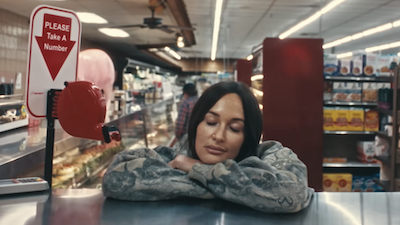
Katherine St. Asaph: “No one is having sex anymore,” intones thinkpiece after thinkpiece, year after year. The repetition is exhausting (and suspiciously fixated on the sexual output of the younger generation). But at the same time, we’re seeing a marked uptick — in that we’re ticking up from basically zero — in pop songs that derive shock value not from increasingly lurid sexual exploits, but from increasingly pornographic scenarios happening alone. We literally just had “juicy hentai”; now the bar is at “I’m sitting on the washing machine.” With this Kacey Musgraves, known for being arch but not crude, casually outfilths pretty much every musician who’s been castigated for less. And I do mean “casually”; this is Musgraves fully inhabiting the plainspoken, winsome charm of her best material. And it’s also a great cheeky vaudeville routine: puns aplenty, filth for ages, and a nod to Shania’s “Whose Bed Have Your Boots Been Under” (although, if I’m nitpicking, I’d swap the order of “ain’t nobody’s boots under my bed” and “ain’t nobody’s tool up in my shed”: start the chorus with a cute li’l reference, then escalate). The best bit might lowkey be “it’s been 335 days,” a protest of Seinfeldian pettiness; it’s like she’s about to pull out a spreadsheet.
[7]
Claire Davidson: Kacey Musgraves’s pop flirtations have yielded diminishing returns for her past two albums now, so I was excited to see her advertise her upcoming project as a hard pivot to her Texas country roots. With a reverb-tinged guitar line and an acoustic jangle, “Dry Spell” does a fine job of evoking the aridity of both her home state and her sexual prospects.
Ironically, though — given how clearly this track is meant to capitalize on her proud Texan background — Musgraves herself might be the most ill-fitting aspect of the song’s composition. The lyrics’ brand of comedy, full of immediate laugh lines like, “I’m so lo-onely / ‘Lonely’ with a capital ‘H,'” is broader than Musgraves typically leans and requires far more theatricality than her subtle delivery allows. Not that her team of producers gives her much support, though: she’s bizarrely buried in the middle of the mix, ostensibly to lend her performance the mystique that her lighter vocal touch doesn’t naturally exude. The album title Middle of Nowhere might be more indicative of where her team has stranded her.
[6]
Alfred Soto: “Dry Spell” is right – Kacey Musgraves hasn’t been interesting since the dawn of Obama II, and I don’t care what y’all say about the unoccupied sunlit corner called Golden Hour. This song has a decent forward rhythm, but it’s ruined by Musgraves’ vocal choices (she sings like a city manager) and absurd anachronistic lyrics. I mean, who in the hell in 2025 knows what “ain’t no new notches on my belt” means?
[4]
Julian Axelrod: Let’s address the tiny blonde elephant in the room: Kacey’s detour into mature and sober (both kinds) folk introspection opened the door for Sabrina Carpenter to claim the horny country crown, establishing herself as the cheeky Dolly to Kacey’s ruminative Emmylou. Now she’s returned to her wry, raunchy roots with the trusty aid of Shane McAnally, presumably after a string of unanswered texts to Jack Antonoff’. In this context, “Dry Spell” feels like a meta-commentary on Kacey rediscovering her sense of humor after years lost in a sea of self-help and pedal steel. There’s a dutiful sense of craft in the way she explores the central conceit from every possible angle, flipping Sabrina’s pun-filled pinup aesthetic into a sexless saunter through the Sahara. You can call it a safe move, but you can’t blame a girl for playing the hits.
[7]
Al Varela: One of Kacey’s most underutilized aspects is her sense of humor, so I’m glad that “Dry Spell” leans into it this much. Despite her dry delivery (pun intended), the song is full of innuendos and scenarios that show how deep Kacey is in the trenches; my personal favorite is “Ain’t nobody but the chickens gettin’ laid.” I like that it’s less about wanting sex and more about recognizing how long it’s been since she’s even tried. I also love the production. Hearing Kacey back on the Texas country train is so exciting, and the sprinkles of Spanish guitar add so much to the outlaw-ish atmosphere of the song.
[9]
Tim de Reuse: I could try dipping in and really unravelling all my niggling issues with the tone of this song, but no matter how I try to formulate an argument, I just keep coming back to: “Lonely with a capital H” is funny. “Lonely with a capital H, if you know what I mean” isn’t.
[5]
Leah Isobel: The concept is so one-dimensional that Kacey writes herself into a corner on the second verse, but the contrast between her laid-back vocal approach and the life-or-death drama of those spaghetti-Western guitars works for me. And as a woman with a tenuous grasp on my own sexuality — how much of it belongs to me, what I can reasonably expect from other people, how my own desire feels in my body, how I want to express it — it’s nice to hear someone sing about wanting to fuck without resorting to overstated sleaze or cutesy, vaudevillian shtick.
[7]
Andrew Karpan: Yearning as a kind of prescriptive function, a form fitting a feeling. If a silly exercise in eroticizing absence, surely it is nonetheless an absence that deserves thought. After a disappointing slog of nothing albums, about divorce, about watching too much anime, after slogging through disinterested half-full half-stadiums with a trawl of yesterday’s failed hippie degenerates like Lord Huron and Father John Misty, it’s enough to make a wistful, once-Album of the Year winning star cry. Oh, Kacey! The grass can only get greener; big rains are surely coming.
[6]
Nortey Dowuona: Time is one of those things that slips past you. The older you get while remaining largely the same doesn’t register until you finally feel your portrait wither and crumble, your oil painting remaining beautiful and lush while you wither away. The fear of this inescapable fact drives some to the tenuous grasps for youthful abandon past 42, the panicked and fearful attempts at maturity at 53, the fury and venom at 64 that you once muttered in your mind but now whinge at strangers on the bus. We promise ourselves we will never do such things, and many of us choose to forget those promises. But many do not. Kacey Musgraves was once upon a time a fiercely pursued, deeply insightful woman, and according to these lyrics is apparently no longer. But her insight is at the forefront, at work trying to sketch out why the once unending and chilling stares that once followed her have finally ceased, and not even out of respect or restraint but disinterest. Now she is a little self-pitying, resentful and sour, but nevertheless accepting of this desire, if unable to render it clearly. Ultimately she decides to end this spell herself, to “take the bull by the horns”. If she does so, will she even find a pair of well-worn boots or a restored pickup she actually likes? Who knows? That’s for us to speculate on and her to hide in the shadows.
[9]