Who’s afraid of little old meh?
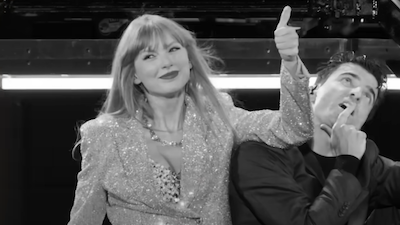
[Video]
[5.25]
Hannah Jocelyn: Hey, she played something with a fucking beat!
[6]
Alfred Soto: An obscenity-laden ode to being as fabulous as Taylor Swift in 2024, “I Can Do with a Broken Heart” is as confident as “My Name Is” and “Izzo (H.O.V.A.).” If the performance sounds cagier, even more tentative than the words and vocal track suggest, blame Jack Antonoff, whose mix turns the instrumental foundation into yesterday’s mud. In all the ways in which I imagined Swift developing, “lyrics first” would not have topped my list.
[5]
Jackie Powell: Part of why “Anti-Hero” remains one of the best songs Taylor Swift has ever written is that the melody is just as strong as the relatable story Swift tells. There’s relatability here too, but the melody is “made to fit the music, rather than the other way around,” an astute observation that Pitchfork’s Olivia Horn made in her review of The Tortured Poets Department. It annoys me that the kick drum that I can’t stop tapping my foot to doesn’t lead to the appropriate burst of emotion in the chorus. This is a song about the compartmentalizing and suppression of raw emotions, yet the hook feels matter-of-fact. Would these lyrics have been more potent if the melody wasn’t so stale? I know a lot of folks have been saying this, but it’s time for Swift to work with someone besides Jack Antonoff.
[5]
Alex Clifton: Witnessing the Eras Tour was an experience unlike any other. It’s an impressive feat of endurance, and it was surreal to know that 70,000 people (including me) had come to watch this one woman do her show. Every so often I had to remind myself: this is real, she’s actually doing all of this, she’s a real human being and yet I can’t think how she does this and has a life offstage. Well, now we know! As a commentary on the Eras Tour, fame, and the parasocial relationship Swift’s fans have with her, it’s pretty neat, and I like that she goes for the grimmer side of the glamour. She has every right to brag about her professionalism here; I can barely get out of bed on bad days, let alone put on a dazzling show. But sonically it’s just another Antonoff plinky-plonky-blippy collaboration; I definitely ignored it the first couple times I listened to Tortured Poets. To me that’s the biggest letdown: a song full of potential that doesn’t quite get to burst and sparkle the way it could. Instead it’s merely fine, 6/10, I don’t hate it but she’s done better. However, I deducted a point because while I try not to care who songs are about, knowing this is likely about Ratty Healy dampened it for me. He’s not worth wasting these kinds of feelings on!
[5]
Jonathan Bradley: The public perception that Swift’s oeuvre centers on lovers and feuds is eternal, yet a subject she has returned to throughout her career has been work, both as labor and as something to take pride in when it’s done well. Work is different for a 34-year-old woman whose job has been songwriter and recording artist since she was 16, but she approaches her toil industriously. The subject has been present in her work since her debut, which had multiple tracks that used songwriting (“Tim McGraw,” “Our Song”) as a structural device, but she turned her attention to labor directly in 2010’s “Long Live,” which wielded the fairytale imagery of “Love Story” and “White Horse” to consider what it means to lead an enterprise — in this case, a touring band — and hope your combined efforts might build a creative legacy. “If you have children some day,” she asked, casting her gaze into the far future. “Tell them how the crowds went wild.” In 2024, the far future is now, and Swift is still working as a songwriter and a member of a touring band, and still conscious of the transcendence that promises and the dull effort required to achieve it. “I Can Do It With a Broken Heart” is a song about being a professional and executing her craft even while she’s falling apart emotionally. “I am so productive,” she promises, a one-woman economic stimulus package. She is condescending (“I’m a real tough kid”) and callous to herself (“lights, camera — bitch, smile”), and offers her disintegrated person (“all the pieces of me shattered”) to a public that demands and maybe deserves all of her. What do the thoughts and feelings of Little Old Her matter in the face of the Taylor Swift Industrial Complex? Yet it doesn’t sound effortful; this is a party song, and heartbeat rhythm and accelerated tempo feels like the anticipation in the hours before an arena show put on by your favorite pop star. The arrangement’s synth-pop pulse oscillates like a radio transmission: dancefloor-ready the way an accelerated revision of Folklore‘s spotlit slow-jam “Mirrorball” might be. (If this were 1996, the maxi-single would contain at least three inappropriately boshing remixes, and we are lesser for their absence.) But “I Can Do It” calls back to another period of Swift’s career too: Reputation, an album that began with a flight to a secluded island and ended with the intimate domesticity of two lovers tidying up the remains of a party. The thesis statement of that album was that, for all her confessional lyrics and public scrutiny, Taylor Swift is fundamentally unknowable even to her most ardent fans. And look! Here she has performed a world-conquering tour, unprecedented in scale, and night after night kept secret this gloom consuming her. “I’m miserable,” she crows as the song culminates, thrilling in subterfuge the way a magician might. “And nobody even knows!”
[10]
Taylor Alatorre: How’d it take Swift this long to have a charting single that uses the word “productive” as the shining centerpiece of its chorus? She’s always had something of the overachieving AP student about her, and Tortured Poets is where she finally stopped trying to hide this and instead decided to make big-budget fanfic out of it. The tinker-toy soundscape, showily but not fussily busy, conjures up a Stephen Biesty cross-section of the inside of the Taylor Swift Hit Factory, all the whirring deadlines and clattering headlines that require teams of professionals to help manage them (“don’t know my schedule on the 5th,” as a smaller-scale pop neurotic put it). In “Broken Heart,” Swift is eager to pull back the curtain from the machine further than she’s ever done, though she naturally stops short of throwing her body upon the gears and wheels Mario Savio-style. I choose to believe that her lilting inflection of the word “it” is an allusion to sex in the manner of the Cole Porter standard, because that’d maximize the song’s fertile intersection between public and private. Even if I’m wrong, though, and this really is just a condensed Behind the Music episode for Every Taylor Swift Break-Up Song, it at least hits the crucial mark of putting entertainment first and autofictional indulgence second.
[7]
Nortey Dowuona: “He said he’d love me all his life!” is a frustrating sentence. At first, it’s simple and cutting, a reminder of the anguish of losing someone who made a flimsy, insubstantial promise in a haze of heady, exaggerated joy then retracted it. The frustrating part is that this doesn’t seem to be the realization — the realization is the betrayal and anger at the betrayal, not an acceptance of the fading nature of the promise. Worse, it’s phrased like “he said — he’d love — me all — his life!”, a leap forward over the four hits of the kick that only appears to jog you out of a stupor. The same effect is meant for “he said — he’d love — me for — all time!”, but the rest of the prechorus settles into that flat stupor. Swift isn’t moved to sing in a deeper or brighter soprano, but returns to the same four measures of quarter notes, so once the chorus appears, it evaporates over the Broadway synthesizers. The synths are also weak, a hidden piano arpeggio flattened by limp pads, and when the drums and real synth line take the forefront, the prechorus synths seem even weaker. The even more frustrating part is that if you have no idea who and what Taylor Swift is, you have no idea who the “he” is who is dragging her into a pit of despair. “He said he’d love me all his life”/”he said he’d love me for all time” appears apropos of nothing and holds no weight; there is no way to make it noticeable unless you phrase it wrong. This is why Jack Antonoff is a bad producer: he can’t prompt the songwriter to provide a more rhythmic or better-written prechorus, so the whole song cannot transition from verse to chorus without gracelessly lashing out.
[4]
Will Adams: My lingering impression of TTPD was that the songs were all so hazy and drumless it might as well have been a two-hour compilation of the “pop song playing in an abandoned mall” genre. Revisiting “I Can Do It…” is refreshing; the drop, once it finally arrives, is fizzy and percolating. But then there are the lyrics. As ever, the tortured poet rears her head here, seemingly pouring out her feelings about the trappings of fame while never revealing too much. Even the attempts at catchphrase — “lights, camera, bitch, smile” — feel guarded.
[5]
Ian Mathers: Keeping the count-in from the producer there in the background is the kind of thing that usually works for me, but it never quite gels here; volume? timing? Who knows. But it’s the kind of not-quite-rightness that seems to be afflicting a lot of Swift’s recent material. The later repetitions of the “birthday”/”plague” lines over the post-Chvrches synths make me think her going full synth pop might actually work in a way I wouldn’t have guessed (or maybe I’ve been listening to too much early OMD recently). Lyrically and thematically this one kind of winds up in the “Anti-Hero” space of… yes, you’ve got a point, and some of the lines work, but no amount of self-awareness makes the ones that don’t clunk any less. As with… everything to do with Swift, it would benefit from everything around her being at least slightly less exhausting/omnipresent.
[6]
Jacob Sujin Kuppermann: Distinctly post-prime in a way that even “Fortnight” didn’t hit. It’s reminiscent of nothing less than Russell Westbrook on the Los Angeles Lakers; she’s hitting all the right poses, putting on a good attitude about the whole enterprise, but nothing ever coheres — the same tricks that worked to varying degrees on the “Mean”-“Blank Space”-“Delicate”-“Anti-Hero” continuum, the intentional conflation of romance, selfhood, and fame, no longer land in quite the same way. What was once clever albeit effortful now is adorned with flop sweat; “lights, camera, bitch smile” and “I’m so depressed I act like it’s my birthday every day” would’ve sounded leaden and cliché even on Lover. Everything is bright and shiny and rather boring — the skeleton of a great Taylor Swift song that in practice can only remind me of past glories.
[3]
Leah Isobel: The more time passes the more I think “Dancing On My Own” should never have happened; the long procession of diluted knock-offs makes the original seem more formulaic, watery, and obvious every year. Taylor’s take on the concept doesn’t bother to invest its mixed emotions with any sort of physical reality: her performance is so Disney-princess smiley, the synth throbs and jittering hi-hats are so wimpy, and that disgusting little piano twing is so… hateful! This is tacky, the performance of performance, and it might work if Taylor had any semblance of camp about her. She does not. This sucks!
[2]
Katherine St. Asaph: The year 2024 has brought two attempts to revamp Britney Spears’ “Lucky“: an explicit cover by Halsey, and this implicit remake by Taylor Swift. Superficially, the three songs are the same: pop stars cry too. Yet in their nuances, they are products of drastically different cultures. The biggest distinction is that unlike Halsey and Swift, Britney didn’t write her single; the main writers were Max Martin and Rami Yacoub (plus ambiguous “additional songwriting” by Alexander Kronlund; maybe he just popped in on a session like on “Side to Side”). Some might be tempted to draw the easy #menwritingwomen conclusion here, but I don’t think that’s quite it. As a songwriter, Martin famously thinks of lyrics as phonics over subtext, and Yacoub is also not a lyricist first. Their skill is to write melodies that sound like they were engraved in the musical scale for centuries; it is not to provide psychological depth. If Lucky has introspected at all on her pain — why do these tears come at night? — Britney doesn’t let on. The song is narrated in third person; even the chorus is just words “they say.” Halsey and Swift, though, write not just in the first person but in a confessional mode. They allude to documented events in their lives, psychoanalyze what drives them and invite you to agree, and openly admit to how they’re offering up their pain for public consumption — all things that are demanded from celebrities far more now than in 2000. Despite Swift’s reputation as pop’s parasocial princess, though, Halsey’s heroine is the one whose hell is basically parasocial: she does it all to be “liked by strangers that she met online.” “I Can Do It With a Broken Heart” is closer to Spears’ idea of celebrity: pop star as remote idol rather than universal bestie. Both songs linger on their sugary hooks, on the glamour and the sequins of it all; they even both rhyme off “winning.” The key difference, though, is that Britney’s Lucky has no agency; she wakes up to handlers knocking on her door, and what she wakes up into is just more dreamsleep. Taylor Swift — or at least the autofictional “Taylor Swift” in this song — is constitutionally terrified of the fact that there are things in life beyond her control. The problem of heartbreak making her miserable is secondary to the problem of heartbreak being a career liability she hasn’t yet addressed. She’s the girlboss’s girlboss; as with “Woman’s World,” you get the sense that “I Can Do It With a Broken Heart” would have killed 10 years ago. In 2024, though, the song doesn’t benefit from that hit of zeitgeisty extramusical energy; it must manage to do it with an outdated heart. The chorus is powered by self-loathing melodrama, like @SoSadToday set to the melody of “Guess I’ll Go Eat Worms.” How much it works depends entirely on how much it gets you to repeat stuff like “I’m so obsessed with him but he avoids me like the plague :D” on chipper singsong autopilot in such situations — and for that, it admittedly works quite well. But the production is thin, as if the “Dancing on My Own” Jack Antonoff liked and bit was the radio edit and not the album version; besides the bubblegum melody, the chorus hardly registers as pop. This should sound show-stopping and manic and iconic; instead it sounds perfectly professional. [ ] Exceeds Expectations [X] Meets Expectations [ ] Below Expectations
[5]